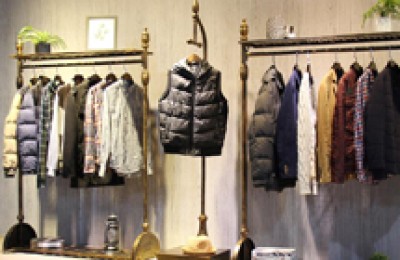

Clothes are one of the necessities of our lives, but do you know the composition of the fabrics of the clothes you wear every day? Nowadays, there are more and more styles of clothing, and the quality of fabrics is also uneven. At this time, we can basically understand the composition of clothing through the information on the clothing tag. However, sometimes the actual situation is inconsistent with the situation on the tag. This time we will Let me explain to you the combustion method in fabric composition analysis to identify the authenticity of the ingredients!
Fabric composition analysis combustion test method
In textile testing Fabric composition analysis is one of the more important projects. After composition analysis, more accurate composition data in the fabric can be obtained. It is one of the main contents of clothing labeling, an important judgment indicator for anti-fraud, and is also decisive for textile performance. factor. The combustion method is the most common method to identify fiber components in daily life. Due to the different chemical compositions of fibers, the combustion characteristics are also different. This allows for a rough estimate of the type of fiber. Take a strand of fabric containing warp and weft from the seam of the fabric, ignite it with fire, observe the state of the burning flame, smell the smell of the burning fabric, and look at the residue after burning.
Fiber combustion characteristics
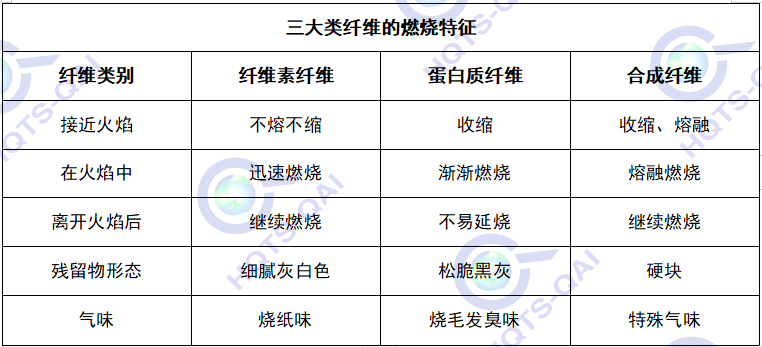
The picture above shows the combustion characteristics of major fiber categories. The following will introduce the combustion characteristics of several common fiber types.
Cotton fiber and linen fiber
Both cotton fiber and hemp fiber ignite as soon as the flame is near, burning quickly and emitting blue smoke. The difference between the smells emitted by the two when burning and the ashes after burning is that cotton emits a paper smell when burned, while hemp emits a grass ash smell after burning. After burning, cotton has very little powdery ash, which is black or gray, while hemp produces a small amount of off-white powdery ashes.
Wool fiber and silk
Wool fiber smokes when exposed to fire, foams when burned, burns slowly, and emits There is a smell of burnt hair, and the ashes after burning are mostly shiny black spherical particles that break into pieces when pressed with your fingers.
Silk shrinks into a ball when exposed to fire. It burns slowly, with a hissing sound, and emits a smell of burning hair. After burning, it condenses into small dark brown spherical ash. It breaks into pieces when twisted by hand.
Nylon and polyester
The scientific name of nylon is polyamide fiber. When near a flame, it quickly shrinks and melts into a white gel. It melts, drips and bubbles in the flame. There is no flame when burning. It is difficult to continue burning without the flame. It emits the smell of celery. After cooling, the light brown molten material is not easy to grind.
Polyester, whose scientific name is polyester fiber, is easy to ignite. It melts and shrinks when it is near the flame. When burning, it melts and emits black smoke, showing a yellow flame and emitting an aromatic smell. After burning, the ashes are Dark brown lumps that can be crushed with your fingers.
Acrylic fiber and polypropylene fiber
Acrylic fiber, whose scientific name is polyacrylonitrile fiber, softens and shrinks near fire, and emits black smoke after catching fire. The flame is white and burns quickly after leaving the flame, emitting the pungent smell of roasted meat. After burning, the ashes turn into irregular black lumps that are easily broken by hand.
Polypropylene, whose scientific name is polypropylene fiber, melts and shrinks when near a flame. It is flammable. It burns slowly away from the fire and emits black smoke. The upper end of the flame is yellow and the lower end is blue, exuding a petroleum smell. , the ashes after burning are hard round light yellow-brown particles, which are easily broken by hand.
Vinylon and chlorofluoron
Vinylon’s scientific name is polyvinyl formal fiber. It is not easy to ignite. It melts, compresses and burns near the flame. There is a little flame at the top. When the fibers are melted into a gel, the flame becomes larger, with thick black smoke and a bitter smell. After burning, small black bead-like particles remain, which can be crushed with your fingers.
Polyvinyl chloride fiber, scientific name: polyvinyl chloride fiber, is difficult to burn and extinguishes immediately after leaving the fire. The flame is yellow, with green white smoke at the lower end. It emits a pungent, pungent and sour smell, and turns into ashes after burning. It is a dark brown irregular lump that is difficult to crush with fingers.
Spandex and fluoronex
Spandex’s scientific name is polyurethane fiber, which melts and burns when close to the fire. The flame is blue and continues to burn away from the fire, emitting a particularly pungent odor. After burning, the ash becomes soft and fluffy black ash.
Fluoron’s scientific name is polytetrafluoroethylene fiber, and the ISO organization calls it fluorite fiber. It only melts near the flame, is difficult to ignite, and does not burn. The edge of the flame is blue-green carbonized. , it decomposes when melted, the gas is poisonous, and the melted material is hard round black beads. Fluoron fibers are commonly used in the textile industry to make high-performance sewing threads.
Viscose fiber and cuprammonium fiber
Viscose fiber is flammable, burns very quickly, and the flame is yellow. It emits the smell of burning paper and has less ash after burning. It is a smooth and twisted strip of light gray or off-white fine powder.
Copper ammonium fiber, commonly known as tiger kapok, burns when close to the flame. It burns quickly. The flame is yellow and emits an ester-sour smell. After burning, there is very little ash, only a small amount of gray-black ash. .
Scenarios where fabric composition analysis is required
1. Sampling inspection and demand of Taobao stores; 2. Tmall’s clear requirements; 3. Customers’ purchase requirements; 4. Whether suppliers are honest in supplying goods, etc.