

Buy moisture-absorbent and breathable T-shirts in the summer, self-heating underwear in the winter, cold-sensing towels for exercise, and skin clothing that is both waterproof and breathable… Have you ever thought about the clothing fabrics that are so intimate with you every day? What cool and crazy high-tech and extremely clever design ideas are hidden inside?
Colorful fabrics丨Pixabay
01
Cool fabric: Summer Angel
I am sweating just standing outside here On a hot day, my friend showed me her cold towel and ice silk sleeves. They are so comfortable! Especially the cold towel, which can be cooled after wiping away sweat, which is very suitable for use in the hot summer.
If you delve into the cooling principle of cold towels, it is actually the simplest physical process of evaporation and heat dissipation. This type of sports fabric used to create a cold feeling has three key actions during use:
-
Water absorption: the towel has the ability to take away heat carrier.
-
Wring: Wring out the excess water.
-
Drying: Compared with ordinary fabrics, the fibers in this “water-absorbing and cooling” cold-feeling fabric can more easily guide moisture to the surface of the fabric, accelerating the flow of air. During the moving process and in the hot summer environment, the moisture on the surface of the fabric turns into water vapor and dissipates into the air. This physical process also takes away the energy of the towel, thereby reducing the temperature of the fabric.

In the past two years, many men have also begun to use sun protection sleeves | Oriental ic
What kind of cooling artifact are ice silk sleeves? In fact, its name just sounds more “icy and cool”. In essence, it belongs to the same family as Lyocell and Modal. It is a regenerated cellulose fiber, which is a product obtained by spinning cellulose as raw material.
Compared with natural cellulose fiber cotton, their performance is somewhat different. For example, ice silk has a stronger moisture absorption capacity than cotton, so it is easier to absorb sweat and keep the skin cool; but if it does not provide additional cooling In terms of treatment, only its own moisture absorption, breathability and sun-shielding functions may cause a cool feeling, and it may not be called high-tech ingredients.
There is also a type of cool-feeling fabric, which is essentially man-made fiber. If some nano-scale jade, composite ores, etc. are added to the spinning raw materials, because the ores have strong thermal conductivity, the silk will feel cold when it comes into contact with the skin. Some cool quilts now use this special fabric.
02
Heating fabric: Turn all other energy into heat energy
Self-heating underwear, which is often used as an advantage in winter, happens to take away heat from evaporated water. The principle is used in reverse: through the process of adsorbing water vapor, or converting water vapor into liquid water, heat is released.

Self-heating underwear advertisement丨UNIQLO
In addition to absorbing moisture and generating heat, it can also generate heat through electric energy. You can think of this type of fabric as an advanced version of an electric blanket: an electric blanket has an electric heating element sewn between two layers of fabric, while electric heating fiber adds electric heating materials to the fiber, such as carbon fiber, silver-plated fiber, etc. . By combining conductive fibers with battery controls, the result is a fabric that can directly convert electricity into heat.
If you want to get rid of the shackles of electric heating fibers that require batteries, there are also light heating fibers to choose from. This kind of fabric adds infrared absorbers to the fiber raw materials to absorb light energy and convert it into heat, such as light energy heating, electric energy heating, etc., which broadens the scope of application of heating fabrics.
03
Quick-drying fabric: Moisture-absorbing and sweat-wicking little angel
Quick-drying fabric perfectly arranges where people’s sweat goes after exercise.
Ordinary cotton fiber can absorb sweat, but the diffusion and evaporation speed of sweat is relatively poor. So when you wear a pure cotton T-shirt to run and exercise, part of your sweat can indeed be quickly absorbed by the cotton T-shirt, but the sweat will stay on the fabric for a long time. When you have finished your run and are walking in the breeze to relax, a sweat-soaked cotton T-shirt will bring you a very bad experience of being clammy and sticky.
Would the experience be better if it were replaced by traditional man-made fabrics with poor hygroscopicity? No, when you sweat, traditional man-made fabrics have difficulty absorbing and evaporating your sweat, causing a stuffy feeling, just like a small walking steamer.

The existing fabrics are unsatisfactory, so to make quick-drying fabrics with excellent performance, we must start from the fibers. One way is to carry out major transformation of polyester, such as DuPont’s approach:
-
Improve water absorption: chemically modify the raw material to make it Contains more hydrophilic groups to wick away sweat.
-
Let the absorbed sweat be quickly transferred to the surface of the fabric: the surface of the spun silk is no longer smooth and round, but has subtle grooves. These fine grooves allow moisture to move more quickly between fibers, achieving the purpose of quickly conducting sweat.
-
Sweat evaporates faster: This grooved fiber structure increases the specific surface area of the fiber, providing more opportunities for sweat to evaporate.
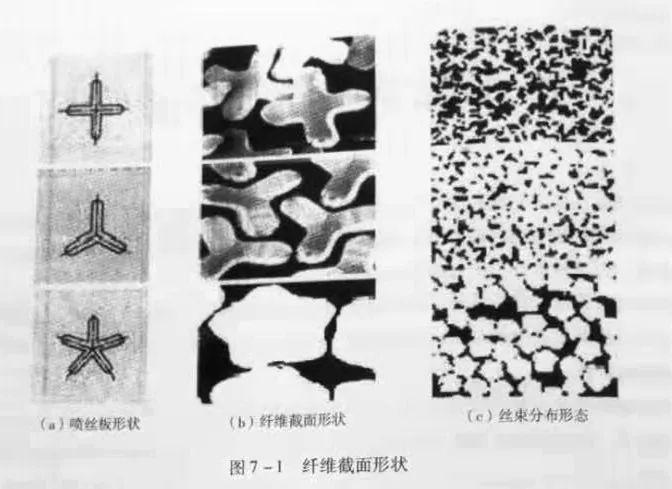
Using different spinnerets to produce moisture-absorbing and sweat-wicking fibers with different cross-sectional shapes, just like using different flower nozzles when decorating a cake丨References [1]
Using such fibers with moisture absorption and perspiration wicking functions to make clothing fabrics can naturally ensure you have a pleasant sports experience. So I have to say something in a low voice: Don’t shake your head when you see that the fabric is made of man-made fibers. It may be a high-tech fiber that has been improved to perform particularly well.
04
Waterproof and breathable fabric: moisture can only escape but not enter
At first glance, this is a very contradictory fabric: it is already waterproof, so what? Can it also let out the sweat and water vapor emitted from the body surface?
The earliest fabric with this function is Ventile: in the absence of water, the fabric dries, the gaps between the yarns are relatively large, and has good breathability; when the fabric is wet When exposed to water, the fibers absorb water and swell, and the gaps between the yarns become smaller, making it difficult for rainwater outside the fabric to penetrate inside.
To put it simply, the moisture itself acts as a “valve”, adjusting the size of the gap in the fabric to determine whether it can allow water to enter.

Today’s waterproof and breathable fabrics mostly use hydrophobic treatment on the inner fabric and hydrophilic treatment on the outer fabric. In this way, the part of the inner layer of the fabric that contacts the skin has poor hygroscopicity and good moisture conductivity, so sweat can be quickly conducted to the outer layer by the fabric after contacting the inner layer. The outer fabric has better hygroscopicity, which can continuously absorb moisture from the inner layer and prevent moisture from returning to the inner layer. Eventually the sweat evaporates on the outer layer of the fabric, and the inner layer of fabric becomes dry and comfortable again after the sweat is discharged.
These four kinds of fabrics with a sense of technology, plus the sun-proof and breathable fabrics mentioned a few days ago, all combine those seemingly ordinary principles to create magic. effect. Rather than the specific craftsmanship in manufacturing, I admire the ingenious design ideas when inventing them. Next time, what high-tech fabrics with unique properties will be born?