
Everyone knows that babies’ skin is delicate and delicate. When buying clothes for your baby, you must choose clothes that are natural cotton and soft in texture. Because cotton clothes are breathable and absorb sweat, the baby will not feel stuffy when wearing them, they are highly comfortable and more suitable for the baby’s skin type. When mothers buy clothes for their babies, they usually look at the material first, and pure cotton is the first choice.
However, most mothers don’t know much about the classification of cotton clothes, and they think that cotton marked on the clothes is safe. In fact, this is not the case. There are many categories of cotton clothes. Mothers must carefully identify them and choose truly safe and healthy cotton clothes for their babies. Today I will teach you how to choose safe cotton clothes for your baby?
1. Classification of cotton clothes
Cotton clothes can be divided into four categories: pure cotton (whole cotton), knitted cotton, combed cotton, and long-staple cotton.
1. The difference between pure cotton and 100% cotton
Pure cotton: refers to the fabric coming from natural cotton. To be precise, it means that the clothing fabric is 100% cotton. Pure cotton fabrics are textiles made of cotton as a textile raw material and made of warp and weft yarns interwoven vertically and horizontally. They are specifically divided into pure cotton gauze, pure cotton poplin, pure cotton fabrics, pure cotton fabrics, etc.
100% cotton: refers to the entire fabric of the garment being 100% cotton. Cotton is a proper term for clothes and other fabric materials. Cotton clothes, cotton towels, cotton bedding, etc. are commonly seen. Its types include plain cloth, poplin, linen, twill, khaki, jalapeno, gabardine, Henggong, denim, Oxford cloth, chambray, linen, velveteen, corduroy, velvet, etc., as many as 20 types. Therefore, cotton means that the fabric is made of 100% cotton.
The difference lies in the different names. Generally, items with a cotton content of more than 75% can be labeled as 100% cotton. Therefore, everyone must pay attention when purchasing and choose 100% cotton or those marked with 100% cotton. The only disadvantage of pure cotton and cotton fabrics is that they are prone to shrinkage and deformation. But it is very skin-friendly and soft, making it very suitable for baby clothing.
2. Knitted cotton
Knitted cotton
Knitted cotton is a fabric made of cotton threads spun by machine. Its manufacturing principle is to use knitting needles to bend yarns into loops and string them together to form a fabric. It has good elasticity, is moisture-absorbent and breathable, and is comfortable and warm to wear. This kind of fabric is very healthy and does not cause any harm to our bodies. It is generally widely used in children’s clothing.
Knitted cotton clothing is also more colorful and generally more fashionable. However, due to the large gaps in the warp and weft of the fabric, its warmth retention is slightly worse than that of pure cotton, and its color fades more seriously.
3. Combed cotton
Combed cotton
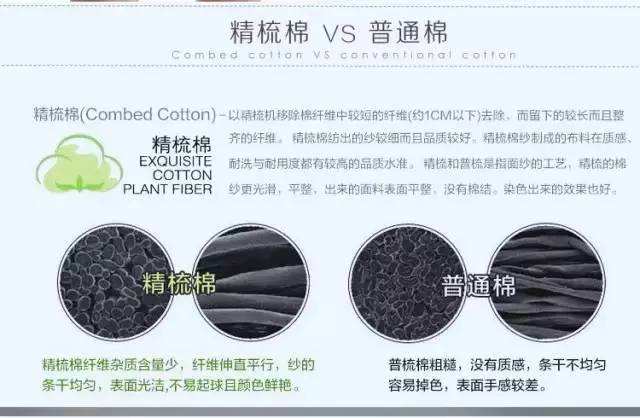
Combed cotton is made by using a combing machine to remove the longer impurity fibers from the cotton fibers. Remove it to make the fibers neat and smooth. This kind of cotton is less dense and the clothes are thicker. The softness is higher than pure cotton when worn, and it is not easy to deform, shrink, and pill. Generally, during wearing, combed cotton also has good hygroscopicity and can absorb 8%-10% of the moisture in the surrounding air, making the clothes more breathable and comfortable.
Combed cotton is generally used in close-fitting clothing, such as socks, underwear, vests and other expensive clothing. The price is also higher than ordinary pure cotton.
4. Long-staple cotton
Long-staple cotton
Long-staple cotton is the preferred cotton with a fiber fineness of 37–38mm. The output of velvet cotton is very small, among which Egypt’s long-staple cotton is known as the “platinum” natural fiber. The best domestic long-staple cotton origin is in the Aksu region of Xinjiang. The natural suede of long-staple cotton clothes is more delicate and softer, and is higher in fineness and strength than ordinary cotton. Down-filled cotton has the advantages of strong warmth retention, good comfort, colorfastness, durability, non-pilling, breathability and sweat absorption. Down-filled cotton is a premium product among cotton fabrics and is generally used in high-end fabrics, clothing, and home textiles. The price of long-staple cotton is also much more expensive than ordinary cotton.
2. What kind of cotton is suitable for babies?
1. First choose 100% cotton or 100% cotton clothing when buying clothes for your baby. At the same time, check whether the clothing labels are complete (the name and address of the manufacturer, product name, specifications, ingredients and content, execution standards, washing methods, product quality level, safety category, certificate, these 8 items are indispensable).
2. Try to choose light colors
Natural cotton is white, so generally colored cotton clothing has been dyed. For safety reasons, when choosing clothes for your baby, try to choose light colors as much as possible, which will be safer and healthier.
3. Choose long-staple cotton
Long-staple cotton is more suitable for baby’s delicate skin and safer.
Long-staple cotton
4. Choose Class A safety grade cotton
The state stipulates that clothing for babies aged 0–3 years must meet Class A safety grade. In this way, we can avoid harmful substances left behind by unqualified clothes and harm the baby’s body. When purchasing, mothers must choose cotton clothing with Class A safety level.