

From the perspective of the physiological characteristics of the human body, women’s appearance has obvious fluctuations, which is suitable for changes in clothing structure. Industrial paper pattern design usually obtains the necessary dimensions from a specification sheet, which is ideal, that is, individual body measurements are not required. However, as a clothing designer, body measurement is essential knowledge and technology, and you must understand the source of the specification and size chart, the technical essentials and methods of measurement, which is very important for a designer to understand the structure of the human body and the construction process of clothing. . Therefore, the measurement referred to here is the human body measurement for clothing design requirements. On the one hand, this measurement standard is consistent with the international clothing measurement standards. On the other hand, it must comply with the basic requirements of clothing pattern making principles. As the pattern design of customized clothing, it shows its superiority even more, but it requires careful and careful observation of the person being tested to obtain the common points and special points with the general body shape. This is an important basis for determining ideal size and a basic principle of anthropometric measurement.
Net size is a parameter that determines the basic model of the human body. In order to make the net size more accurate, the person being measured should wear tight-fitting clothing. Another explanation of the net size is called the inner limit size, which is the minimum size. For example, bust, waist, hip and other circumference measurements do not add any slack. On this website, net dimensions will be indicated by adding “°” to the size code.
1. Fixed-point measurement Fixed-point measurement is to ensure that the measured dimensions of each part are as accurate as possible and to avoid guessing based on experience. For example, circumference measurement first determines the concave and convex points at the measurement position, and then makes a horizontal measurement; length measurement is the sum of the relevant measurement points, such as sleeve length is the sum of the lines connecting the shoulder point, elbow point, and ulna point.
2. Centimeter system measurement The soft ruler used by the measurer must be in centimeters, so that it will be consistent with the standard unit.
Datum points and baselines of anthropometric measurements
1. Main datum points
①Frontal Neck Point (FNP): This The point is located at the midpoint of the connection between the left and right clavicle, and is also the front midpoint of the depression at the base of the neck.
②Side Neck Point (sNP): This point is located at the intersection of the side of the base of the neck and the shoulder, and is also the point where the base of the ear points vertically downward.
③Back Neck Point (BNP): This point is located at the seventh cervical vertebra of the human body. When the head is tilted forward, its protruding part can be easily touched.
④Shoulder end point (SP): It is located at the end point of the left and right shoulders of the human body and is the reference point for measuring shoulder width and sleeve length.
⑤Breast height (BP): the highest point of the chest, that is, the position of the nipple. It is a very important reference point when dealing with bust darts in the structural design of women’s clothing.
⑥Anterior axillary point: It is located at the junction of the human body’s arms and chest. It is the reference point for measuring the width of the chest.
⑦Back axillary point: It is located at the junction of the human body’s arms and back, and is the reference point for measuring the width of the back.
⑧Sleeve elbow point: It is located at the elbow joint of the human arm and is the reference point for determining the concave potential of the sleeve curve line.
⑨Kneecap point: It is located in the center of the knee joint of the human body.
⑩Ankle bone points: The protruding parts on both sides of the ankle.
⑨Head point: When standing in a correct posture, the highest point of the head is located on the center line of the human body. It is the reference point for measuring overall height.
⑥Styloid point: Also called the hand root point, the tip of the styloid process at the lower end of the radius is the reference point for measuring sleeve length.
⑥Outer ankle point: The protruding point of the ankle bone on the outside of the ankle, which is the reference point for measuring pants length.
⑩ Intestinal spinous point: At the upper anterior iliac spine of the pelvis, that is, lying on your back, you can touch the most prominent point of the pelvis, which is the location of the mid-hip circumference line.
⑤ Trochanter point: It is at the greater trochanter of the thigh bone, at the fullest part of the side of skirts and trousers.
2. Main baselines
① Neck circumference line (NL): It is the baseline for measuring the length of the human neck circumference, passing through the left and right side neck points (SNP) and the back of the neck point. (BNP) and anterior cervical point (FNP) measurements.
②Bust line (BL): The horizontal circumference line passing through the highest point of the chest is the baseline for measuring human bust size.
③Waist line (wL): The horizontal line passing through the thinnest part of the waist is the baseline for measuring the waist size of the human body.
④Hip line (HL): The horizontal line passing through the fullest part of the hip is the baseline for measuring the size of the human hip.
Measurement site
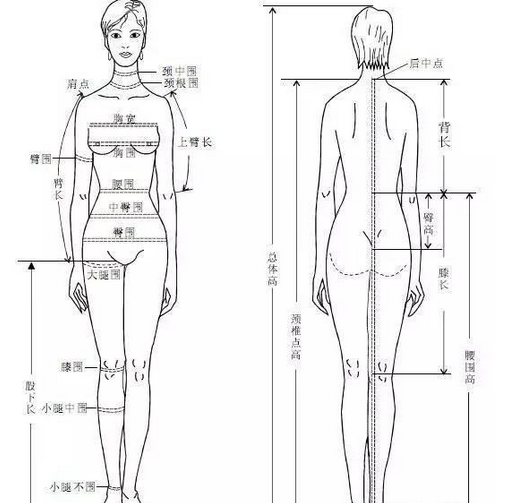
Overall height: The distance measured vertically downward from the top of the head to the ground when the human body is standing.
Height: Measure vertically downward from the seventh cervical vertebra point to the ground.
Back length: measured vertically downward from the seventh cervical vertebra point to the center of the waist.
Front waist length: measured from the shoulder and neck point through the chest height point to the waist line.
Cervical vertebra point height (i.e. height): the vertical distance from the seventh cervical vertebra point to the ground.
Sitting cervical vertebra point height: when a person is sitting on a chair, measure the vertical distance from the seventh cervical vertebra point to the chair surface.
Breast height: the length of the body measured from the shoulder and neck point downward to the nipple point.
Waist height: The distance measured vertically from the center of the waistline to the ground is the basis for pants length design.
Hip height: measured from the waistline at the back of the body to the highest point of the buttocks.
Thigh length: the vertical distance measured from the waist line at the back of the body to the gluteal groove.
Fromale length: measured from the gluteal groove downward to the ground.
Arm length: measured from the end of the shoulder down to the point of the stem.
Upper arm length: measured from the end of the shoulder downward to the point of the elbow.
Hand length: from the stem to the protruding pointMeasure down to the length of the tip of your middle finger.
Knee length: measured from the waist line in front of the body to the midpoint of the knee.
Girth: Measure the horizontal circumference along the waistline past the height of the chest.
Waist circumference: measure the length of one week horizontally through the thinnest part of the waist.
Hip circumference: measure horizontally around the fullest part of the buttocks.
Mid-hip circumference: Measure the length of one week horizontally between the waist and hip circumference.
Head Circumference: Measure the circumference of the head through the center of the forehead, above the ears and occipital bone.
Basic collar circumference: measure the length of one week around the human neck through the shoulder and neck points, the seventh cervical vertebra point, and the front cervical dens.
Neck circumference: Measure the circumference around the middle of the neck through the Adam’s apple.
Inframammary circumference: the length of one week measured horizontally around the lower end of the breast.
Armpit circumference: Measure the length from the back armpit point through the shoulder end point to the front armpit point and through the armpit circumference.
Arm circumference: measure the length of one week horizontally around the thickest part of the upper arm.
Elbow circumference: The length of one week measured around the elbow joint.
Wrist circumference: measure the length of one week around the styloid point of the wrist joint.
Palm circumference: The thumb is naturally bent inward, and the length of the circumference is measured through the base of the thumb.
Hip circumference: Measure the length of one circle around the crotch through the hip joint.
Thigh circumference: measure the length of one week at the level of the thigh.
Knee circumference: measure the length of one circle horizontally through the midpoint of the knee.
Medium calf circumference: the length of one week measured horizontally around the fullest part of the calf.
Calf circumference: the length of one week measured horizontally around the thinnest part of the upper ankle bone.
Shoulder width: measured from the end of the left shoulder through the midpoint of the back of the neck to the end of the right shoulder.
Small shoulder width: measured from the end of the shoulder to the point of the shoulder and neck.
Chest width: measured from the left armpit point of the front chest to the right armpit point horizontally.
Nipple distance: measured horizontally from the left nipple point to the right nipple point.
Back width: the actual length of the body measured along the body surface from the left rear axillary point to the right rear axillary point on the back.
Measurement methods of different clothing styles
Clothing pattern makers not only make patterns based on clothing renderings or photos (pictorials, magazines…) Model design; sometimes we often receive actual samples from customers (a piece or a set of processed clothing styles) for structural design (commonly known as sample rejection). At this time, the size of the main parts of the clothing style and other sizes specified by the customer must be carefully measured. Since there are many types of clothing styles, we will introduce the conventional measurement methods and the dimensions of the main parts.
1. There are three measurement methods for clothing length (L) (to be determined according to the requirements specified by the customer):
①Front clothing length (L1): from the side of the neck point (SNP ) to the bottom edge of the front panel.
② Back garment length (L2): The length from the side of the neck point (SNP) to the bottom edge of the back garment piece.
③Back center length (L3): the length from the back neck point (BNP) to the bottom edge of the back piece.
2. Bust (B) When the buttons are buttoned or the zipper is zipped and the clothes are laid flat, the distance measured horizontally along the bottom of the armhole is 1/2 of the bust size.
3. Waist circumference (W) At the waist line, according to my country’s standard female 160/84A body shape, the length of the front waist section from the side of the neck point (SNP) to the waist line (WL) is about 41cm] The distance measured horizontally is l/2 of the waist size.
4. Hip circumference (H): Measure horizontally at 16-18cm below the waist line. The measured distance is 1/2 of the hip circumference size.
5. The size of the hem is measured horizontally at the bottom edge (if it is a jacket with elastic bands, you need to measure the dimensions when the elastic bands are stretched and when the elastic bands are not stretched).
6. Shoulder width (S) There are two ways to measure shoulder width:
① Whole shoulder width (S1): measure from the end of the left shoulder through the seventh cervical vertebra to the end of the right shoulder length.
② Small shoulder width (2): the length from the neck side point (NP) to the shoulder end point (P).
7. Sleeve length (SL) There are two measurement methods for sleeve length:
①SL1l: Measure from the shoulder end point (P) to the cuff edge.
②SL2: Measure from the back of the neck point (BNP) through the shoulder end point (SP) to the edge of the cuff.
8. Cuff (CW) The cuff is the measurement around the cuff.
9. Collar circumference (N) Flatten the collar and measure the distance from one end to the other (due to different collar types, the specific measurement methods are different)
10. Front straight The open collar is measured vertically from the horizontal line at the side of the neck point (SNP) to the vertical distance where the front collar arc falls.
11. Back horizontal open collar: 1/2 of the straight-line distance between the left and right neck side points (SNP) (which is different from the arc length of the back neckline).
12. Bust line depth: measure the vertical distance from the side of the neck point (SNP) to the bust line.
13. The height of Xiushan is measured from the top of Xiushan to the vertical distance of Xiuzhuang line.
14. Sleeve enlargement (sleeve fat) Measure the size of the sleeve at the position of the sleeve enlargement line.
Other dimensions include chest width, back width, bag mouth size, left and right, up and down positions, button size, left and right, up and down positions, the shape and position of the dividing lines of each part…
p>