

Feather velvet (fine denier silicon fiber)
[English name]: FEATHER FABRIC, also known as filament down.
To be precise, it is a polyester fiber that is close to down in terms of fineness. It has the characteristics of down, but it is not down. It is “imitation down” and is usually called “feather velvet” in the market. .
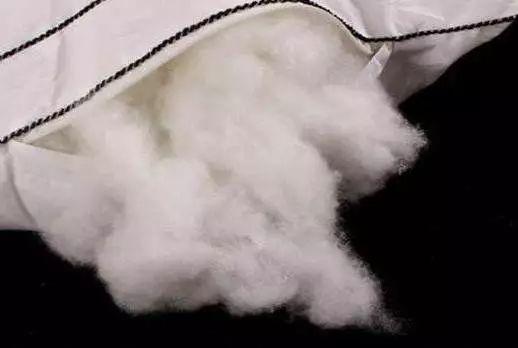
Feather velvet/down cotton/feather silk cotton
The fineness of down velvet fiber is a fraction of the common four-hole, seven-hole fiber on the market, and is currently the best in the country The microfiber ranges from 0.8-2.5D. Due to its fineness and the addition of silicone oil, down velvet is softer, smoother and has a better touch.
Advantages of down velvet
1. Soft down-like feel.
2. Down-like lightweight feel.
3. After being opened, the appearance is similar to down, and after being made into bedding, it has down-like comfort.
Common uses of down velvet
Feather velvet with fine denier silicon fiber 0.78dtex32mm is mainly used to replace down. It is passed through a cotton card clothing opening machine or After the carding machine is opened, it is used as a filler to make pillow cores, cushions, quilts, cold-proof clothing, etc. after the blowing process;
Feather velvet micro-denier silicon fiber 0.78dtex51mm is mainly used to make high-end clothing. Lining, imitation goose cotton, imitation silk cotton, high-grade non-woven fabric, directly laid net or mixed with other hollow fibers and then laid net to make high-grade silk quilt.
How to identify down velvet
1. Feather velvet is superfine fiber, and the fabric must have high count and density. If the fabric does not meet the requirements, the quilt will look like A bad down jacket has velvet leaking out like that. Some cheap quilts are now being swindled under the banner of velvet quilts.
2. The texture of the down velvet quilt is very soft, similar to that of a high-quality down quilt. When you pinch the filling inside, you will find that the fibers are very delicate and smooth.
3. The quilt will be very flat when rolled up, because the physical properties of down velvet are the same as down, locking air to achieve efficient warmth retention.
Washing of feather velvet
It can be dry cleaned or washed: soak it in water for half an hour, rub it gently with your hands to let the dust come out, and put in an appropriate amount Use neutral detergent; do not tumble dry, lay flat to dry; do not wring in washing machine, which will affect warmth retention; do not twist hard after washing, let dry naturally.
The difference between down velvet and down
Feather velvet
Feather velvet is as soft and slender as natural down, with an excellent feel and Warmth retention, the fine and dense fiber layer can lock the air and produce a stable still air layer, which can keep warm and prevent cold.
Adequate silicon processing and moderate curling give the fiber a good feel. The fibers are not easy to tangle with each other after long-term use (compared to ordinary hollow fibers). The down velvet used as the quilt core can be After further processing (laying, hot-melt lamination, etc., it becomes a complete sheet of feather silk cotton), the quilt core made from it is not easy to run away and clump, and always maintains excellent fluffiness.
Its warmth and fluffiness can also be compared with natural down. At the same time, its chemical fiber nature gives it the advantages of being resistant to mold and mites, easy to store, and washable, especially for people allergic to down. Especially suitable for people.
Down
Compared with down velvet, down material has better performance in most aspects, but its moisture-proof and moth-proof properties are not as good as down velvet. Among the four natural thermal insulation materials: cotton, silk, wool, and down, down has the best thermal insulation properties. From the perspective of warmth retention, there is currently no thermal insulation material in the world that surpasses the thermal insulation performance of down. Down has a star-shaped structure, each velvet is fish-scale-shaped, and countless tiny pores contain a large amount of still air. The air conductivity coefficient is the lowest, which results in good warmth retention of down. At the same time, down also has strong moisture absorption and dispersion properties. When people sleep, the body continuously emits sweat outwards. Down can continuously absorb and discharge the sweat released by the human body, making the body feel No feeling of humidity and stuffiness.