
When it comes to spunlaced non-woven fabrics, here we have to talk about something that beauty-loving girls often use, and that is face towels. Many people have not thought that the face towels we often use are spunlace non-woven fabrics. Let’s take a look at what spunlace non-woven fabric is and what are its advantages?
Spunlaced non-woven fabrics spray high-pressure fine water onto one or more layers of fiber webs to entangle the fibers with each other, so that the fiber webs can be reinforced and have a certain strength. The resulting fabric is It is spunlaced non-woven fabric.
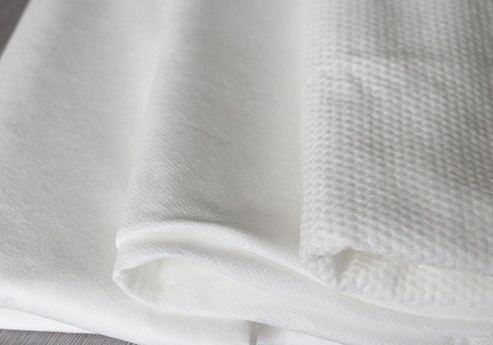
Characteristics of spunlace cloth
1. Flexible entanglement, does not affect the original characteristics of the fiber , does not damage the fibers;
2. The appearance is closer to traditional textiles than other nonwoven materials;
3. High strength, low fluff;
4. High hygroscopicity, rapid moisture absorption;
5. Good breathability;
6. Soft feel, good drape;
7. Variety of appearance;
8. No need for adhesive reinforcement and washable;
9. Long production process and large floor space;
10. Complex equipment and water quality requirements High;
11. High energy consumption.
Introduction to spunlace non-woven fabrics
Spunlace non-woven fabrics spray high-pressure fine water onto one or more layers of fiber webs to entangle the fibers with each other. The fiber web is reinforced and has a certain strength, and the resulting fabric is a spunlace non-woven fabric.
Processing principle
Using multiple fine water jets generated by high pressure to spray the fiber web. After the water jet passes through the fiber mesh, it is rebounded by the dragging mesh curtain and penetrates the fiber mesh again. As a result, the fibers in the fiber mesh are displaced, interspersed, tangled and cohesive under the hydraulic action of the high-speed water jets in different directions. Thus the fiber web is reinforced.
Prospects of spunlace fabrics
Due to the advantages of spunlace fabrics, spunlace fabrics have become an area of rapid technological progress in the nonwoven industry in recent years. The development direction of non-woven fabrics is to replace textiles and knitwear. Spunlace fabrics have the most potential to compete with the textile market due to their most textile-like characteristics, excellent physical properties, and high quality and low price.
Spunlaced cloth material; polyester + viscose; material ratio; 100% polyester; 10% polyester + 90% viscose; 20% polyester + 80% viscose; 30% polyester + 70% viscose Glue; 40% polyester + 60% viscose; 50% polyester + 50% viscose; 60% polyester + 40% viscose; 70% polyester + 30% viscose; 80% polyester + 20% viscose; 100% viscose glue.
PS: Spunlace fabric needs to provide specific material (polyester, viscose) ratio to the manufacturer, so as to get a quotation~
Spunlace texture:
Plain grain, mesh grain, pearl grain, F grain, cross grain, etc.
Uses of spunlaced non-woven fabrics:
① Medical and sanitary non-woven fabrics: surgical gowns, protective clothing, disinfection wraps, masks, diapers, civilian rags, wipes , wet facial wipes, magic towels, soft towel rolls, beauty products, sanitary napkins, sanitary pads and disposable sanitary cloths, etc.
② Non-woven fabrics for home decoration: wall coverings, tablecloths, sheets, bedspreads, etc.
③ Non-woven fabrics for clothing: linings, adhesive linings, wadding, styling cotton, various synthetic leather base fabrics, etc.
④ Industrial non-woven fabrics; filter materials, insulation materials, cement packaging bags, non-woven geotextiles, covering fabrics, etc.
⑤ Non-woven fabrics for agriculture: crop protection fabrics, seedling raising fabrics, irrigation fabrics, thermal insulation curtains, etc.
⑥ Other non-woven fabrics: space cotton, thermal insulation and sound insulation materials, linoleum-absorbing felt, cigarette filters, tea bags, etc.