
The advent of the Internet era has brought about tremendous changes in the way we shop. With the help of the Internet, we can now buy our favorite products at home at the touch of a finger. While online shopping brings us convenience, it also has some regrets. For example, when buying clothes, because everyone’s body shape is different and there is no opportunity to try on clothes, most of the time when we buy clothes online, we cannot buy the right size. Either they are too big or too small. Friends who are not afraid of trouble will return and exchange them again and again. Friends who are afraid of trouble will wear them as long as they can wear them, or they will just throw the clothes in the corner to gather dust. Therefore, it is very important to choose the size that suits you when shopping for clothes online.
I believe that many students who buy clothes on the website follow the following methods to choose sizes:
- 1.
By feel. I always wear size M clothes or size 30 pants, so I just choose the size I usually wear. This size selection method can select clothing sizes at a time with an accuracy of no more than 50%, because each original factory’s clothing has different “size” settings. This has led to many handsome boys and fairies buying clothes that clearly match their size, only to find that they are either too big or too small for them.
- 2. Read reviews and buyer Q&A. Take a look at the reviews of clothes bought by people in the past. Many enthusiastic buyers will post their height, weight, and pictures for reference
- 3. Ask customer service. Report your height and weight data to customer service, and then ask customer service to give recommended clothing sizes
- 4. For some more user-friendly online stores, the shopkeeper will post a rendering of the model trying it on. The model’s body and body shape data are also given for everyone’s reference.
Even if you use the above methods, I believe you will still encounter the wrong size of clothes many times. Because the clothes of many brands (especially some international brands) have their own set of “size” definitions, and the same person may have the same height and weight, but their body shape will also be different. When choosing a size, don’t be too obsessed with “large, medium, small”, and don’t just give your height and weight and let customer service recommend a size for you.
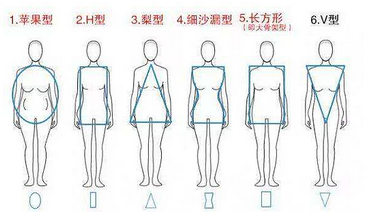
Common body types
As the saying goes, only by knowing the enemy can you be victorious in every battle. Handsome boys and fairies, if you want to choose clothing of the right size, you must first understand the clothing size, then you must know the parameters of your body shape, and then choose the corresponding clothing size based on your body shape parameters. (Dizzying with size parameters? Don’t be afraid of trouble, it’s not difficult at all. Read on with me)
Clothing size standards
We live in a unified world. In order to make production activities More convenient and more economical, everything has rules and standards. It ranges from length units, weight units, safety standards, to A4 paper size, quilt cover size, etc. The same is true for clothing. There is also a set of size standards. This set of standards is different according to gender, age and clothing type. my country’s current clothing size standards:
- “GB/T 1335.1-2008 Clothing sizes for men”
- “GB/T 1335.2 -2008 Clothing Sizes for Women”
- “GB/T 1335.3-2008 Clothing Sizes for Children”
The complete set has 3 independent standards for men, women and children, 3 All items are recommended standards. The new standard uses height, bust, waist and waist drop as the basis for naming models. For each model, it lists the 10 key control parts necessary for making clothing. Most of the clothing in our country is designed and produced according to this set of standards. I won’t go into too many professional details here. Let’s first understand a few special terms:
1. [Size]: Yes Indicates some basic dimensions of clothing, that is, the size of clothing
- No.: refers to the height of the human body, expressed in centimeters, (example: 170)
- Type: refers to the bust or waist circumference of the human body, expressed in centimeters, and is the basis for designing and purchasing clothing. The top refers to the bust (example: 92), and the bottom refers to the waist (example: 74) (P.S: some people with small waists and large hips also need to consider the hip circumference)
So, we need to be clear. : Everyone can use the same “number” when buying clothing, but not the same “type”, because there is only one “number”, but the “type” is divided into tops and bottoms. Tops generally refer to the basic bust, and bottoms generally refer to Basic waist circumference
2. [Body shape]: The body shape is divided based on the difference between the chest circumference and waist circumference of the human body. It is divided into four categories, generally represented by Y, A, B, and C
- Y: Indicates a thin body type, the difference between bust and waist is 19cm~24cm
- A: Indicates a normal body type, bust and waist circumference The difference in waist circumference is between 14cm and 18cm
- B: Indicates a fat body type, indicating that the difference between bust and waist circumference is between 9cm and 13cm
- C: Indicates an obese body type, It means that the difference between bust and waist is between 4cm and 8cm
So, if you are 170cm tall, your basic bust is 92cm, and your basic hipcm is 74cm, you are suitable to wear a 170/92 top. 170-74 bottoms.