
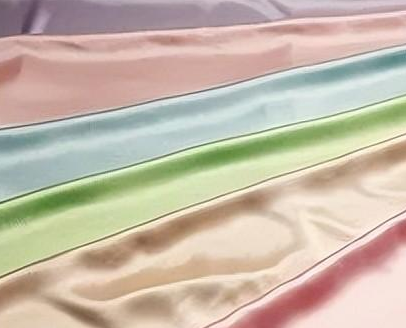
Triacetic acid fabric looks like silk at first glance, with a delicate pearlescent luster on the surface. But it is easier to take care of than silk, and it feels refreshing and comfortable to wear. It has won the favor of many fashionistas with its silk-like luster, cool feel, and excellent drape.
In recent years, triacetate fabrics have often appeared in Marc
Jacobs, Alexander Wang, Acne
Studios’ haute couture show is one of the must-have fabric categories for spring and summer used by many big brands, and it is also the focus of pursuit by major luxury brands. What exactly is triacetate fabric? Can it really be compared to silk? The following is a little knowledge about triacetate fabrics for everyone to better distinguish and choose.
Triacetate fiber is a type of cellulose acetate (Cellulose Acetate, referred to as CA). It is made of cellulose as raw material and is chemically synthesized. Chemical fiber made from cellulose acetate. Cellulose acetate with an esterification degree above 2.7 is tri-cellulose.
Acetate (TCA for short), which is used as raw material to make a film, and is spun into triacetate fiber after relevant processing. Simply put, it is regenerated cellulose fiber made from natural wood pulp. It is a new type of fiber developed by Mitsubishi Corporation of Japan that combines nature and high technology.
Triacetate fiber is sought after, mainly because it can compete with mulberry silk in performance and is recognized as a simulated silk fiber. Triacetate fiber has a gloss similar to mulberry silk, drapes smoothly, is very soft and has a cool touch when in contact with the skin. Compared with polyester fiber, it has good water absorption, strong quick-drying properties and is not prone to static electricity. More importantly, it overcomes the shortcomings of silk-wool fabrics that are difficult to care for and wash. It is not easy to deform when washed, is not easy to wrinkle, and is easy to care for. In terms of sustainable development, triacetate fabrics use high-purity wood pulp as raw materials, and the raw materials come from sustainable ecological forests under good management. They are sustainable materials and eco-friendly.
Which one is better, triacetic acid or mulberry silk? The two fibers can be said to have their own merits. Triacetate fiber is similar to mulberry silk in appearance, feel and drape. From a professional point of view, in terms of mechanical properties, the strength of triacetate fiber is low, the elongation at break is large, the ratio of wet strength to dry strength is low, but higher than that of viscose yarn, the initial modulus is small, and the moisture regain is Mulberry silk is low, but higher than synthetic fibers. Its wet strength to dry strength ratio, relative hook strength and knotting strength, elastic recovery rate, etc. are not much different from mulberry silk. Therefore, the performance of acetate fiber is closest to that of mulberry silk among chemical fibers. Compared with mulberry silk, triacetate fabric is not so delicate. Clothes made from it are not easy to wrinkle, can maintain the shape well, and are easier to maintain and take care of on a daily basis.
Mulberry silk, known as the “Queen of Fibers”, is skin-friendly, breathable, smooth, soft, noble and elegant, but its shortcomings are also obvious. Maintenance is troublesome, and the low color fastness is also a weakness of natural fabrics. After understanding these advantages and disadvantages, you can choose the fabric that suits you according to your needs.
The simple way to identify silk and triacetate fiber is the burning method. Silk fiber has the smell of burnt feathers after burning, and the ashes are brittle and hard. Triacetate fiber does not melt or shrink when it is close to the flame. It melts and burns in the flame and contains acetic acid. taste.