
There are different types of T-shirts, so different T-shirt fabrics are also different. So what are the common T-shirt fabrics? What fabric T-shirt is the best? Better? What ingredients are generally added to T-shirt fabrics?
Why do some T-shirts sell for more than 10 to 20 yuan, and some cost 50, 60 or even hundreds of yuan? The reason is the fabric The differences, understanding these T-shirt fabrics will help us to easily identify and buy high-quality T-shirts in the future.
Sirospun T-shirt fabric:
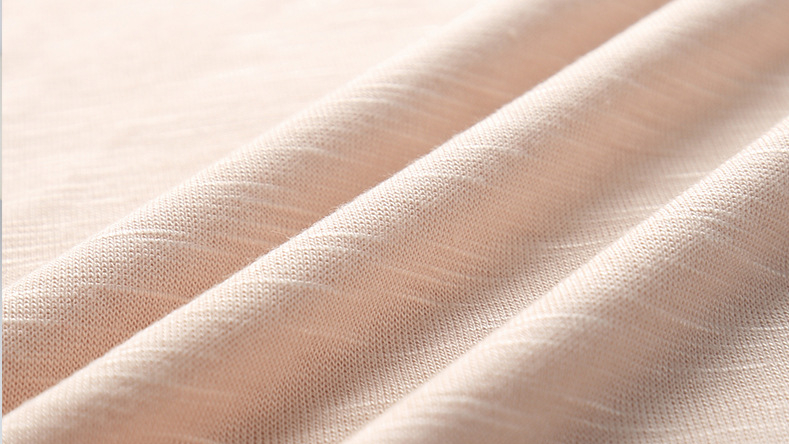
Siro spinning Two rovings kept at a certain distance are fed into the spinning machine. After drafting, the two single yarn slivers are output from the front roller, and due to the transmission of twist, the single yarn sliver has a small amount of twist, and the splicing It is then further twisted into a ply-like yarn and wound on a bobbin. This process is often seen in high-quality T-shirt fabrics.
Characteristics of siro spinning: less hairiness, high strength, and good wear resistance. It can achieve the effect of single yarn weaving of wool yarn to achieve the lightness and thinness of wool fabrics.
Most of the fabrics listed above are common in round-neck T-shirts. The lapel T-shirt that must be mentioned in T-shirts is the fabric used in POLO shirts and ordinary There is also a clear difference in the round neck T-shirt.
Pure cotton T-shirt fabric:
Pure cotton T-shirt, needless to say, 90% of the products on the market Most T-shirts are said to be pure cotton. Many merchants on the market will only say that if the cotton content reaches 75%, it is pure cotton, and 100% cotton is pure cotton. But in fact, according to strict standards, whether it is pure cotton or 100% cotton, it can only be called “pure cotton” or “whole cotton” when it is 100% cotton.
And if it is 100% pure cotton or 100% cotton, it also has its shortcomings and limitations. For example, clothes are easy to wrinkle and shrink easily. The editor of T Club will not talk too much about the advantages of pure cotton T-shirts, because everyone knows and has worn them. The main point the editor wants to talk about is why some of the same pure cotton T-shirts are so expensive and some are so cheap?
The reason for the price difference is related to the following points.
Cotton types: divided into fine-staple cotton and long-staple cotton. Fine-staple cotton is divided into grades 1 to 7, and long-staple cotton is divided into grades 1 to 5; the higher the grade, The larger, the worse the quality, that is, level 1 is the best. At the same time, the price of cotton will be different depending on its origin. For example, Egyptian long-staple cotton is of better quality than Xinjiang long-staple cotton.
Spinning quality: Spinning is divided into two types: combed and carded. Combing involves specific classification on the spinning machine to clean up impurities and then sort them. Generally, the single yarn length is more than 25mm and has good gloss, making the fabric smoother and more high-end. Because the single yarn is longer, it is less prone to fluffing and pilling after wearing. .
Thread count density: Fabrics with high count yarns are generally thinner than fabrics with ordinary yarns. Below 40 yarns are ordinary yarns (excluding 40 yarns), and above 40 yarns are high-count yarns. Of course, the higher the yarn count, the more expensive the cotton yarn will be. Those fabrics on Taobao that only sell for about 100 yuan are marked with the so-called 40S and 133*72 fabrics. They are basically “free upgrades”. If they can give you 128*68, they are good.
Fabric structure: For the same yarn count, the quality of twill weave is better than that of plain weave. Of course, the price will also be different.
Dye material: low-cost fabrics. The first consideration is cost, so inferior dyes will be used. The fabric itself will contain formaldehyde, PH value, color fastness, and decomposable aromatic amines. Problems such as excessive carcinogens.
Printing and dyeing methods: Printing and dyeing are divided into pigment printing and reactive printing. The imitation printing mentioned on the Internet is still pigment printing. The process is different and the price is different. The quality and cost of reactive printing and dyeing are higher than that of pigment printing.
Of course, there are some factors that determine the quality of fabrics, which are the processes in the production process, such as trimming, singeing, stretching, calendering, etc. The specific technical Details all determine the cost.
So these are the differences in the price of the same pure cotton T-shirt.
There are many types of fabrics for pure cotton T-shirts, so the pure cotton T-shirts seen on the market may have different names, and there are also differences between them. Different. For example: combed cotton and ring-spun cotton
Combed cotton T-shirt fabric:
Commonly seen clothing fabrics When introducing the ingredients, you may see combed cotton, so is combed cotton pure cotton? In fact, combed cotton is also pure cotton, and it is a type of pure cotton. As the name suggests, combed cotton represents this T-shirt. The fabric of the T-shirt is a yarn produced by adding a combing process in the textile process. The advantage of this kind of fabric is that it will make the T-shirt softer and smoother, and the corresponding one is carded, which is I won’t explain too much, but naturally it is not as good as combed cotton. Combed cotton has better hygroscopicity and air permeability than ordinary cotton. Compared with ordinary cotton, it is more high-end, has better gloss, is smoother, more comfortable, more washable and durable. �Not suitable for people with allergies. The fabric has poor stiffness and is not suitable for hanging. It will become longer and longer, and it is easier to deform. I believe everyone knows this.
Piqué cotton/pineapple T-shirt fabric:
Piqué cotton is a kind of knitted fabric. The English translation of PIQUE means that the surface of the cloth is porous, like a honeycomb. It is more breathable, drier and more washable than ordinary knitted cloth. It is also a popular fabric in custom-made T-shirts.
Because its texture is special and easy to identify, some people also call it “pinecloth”. It absorbs sweat and is not easy to deform. It is generally used as a T-shirt. T-shirts, sportswear.
Many big brand POLO shirts are made of pique cloth. Pique cotton T-shirts adopt a pique structure, which has very good air permeability and moisture permeability, and feels soft. Pique cotton has very good air permeability and moisture permeability, a soft feel, and a soft and casual appearance. It is not easy to deform after washing and is machine washable. That’s ok too.
Cashmere T-shirt fabric:
Cashmere is a winter clothing fabric in everyone’s impression, but now this High-end fabrics are also used in POLO shirts. The common cashmere polo shirts on the market are 80% cotton and 20% wool.
You may wonder, don’t you wear wool in summer? Yes, in fact, not only is cashmere not hot when worn on the body, it is also very high-grade and has become a lot of business A high-end choice for people.
Functional fabric T-shirt fabric:
Functional Polo shirts are generally for athletes. Silver is added to this fabric to reduce sweat odor, and it also contains sunscreen ingredients that can resist UV rays. Sports polo shirts are usually made of lighter synthetic fibers or blended fabrics. Functional Polo
Because of the difference in brand value and market input cost, the price of shirts varies greatly. However, this type of Polo shirt is best worn when playing basketball or training, and cannot be worn everywhere.