
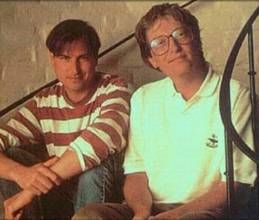
A photo of Gates and Jobs in the late 1990s, between the two The difference is only three buttons.
For those of us in the industry, Bill Gates and Steve Jobs have left a lasting legacy by transforming the IT industry from business attire freed from the constraints. It is precisely because of their insistence on informal attire that we ourselves have been able to wear comfortable clothes to get off work since the 1990s.
Regarding the choice of clothing, Jobs and Gates actually have different effects. Jobs hated buttons and buttons. Therefore, there are no buttons on his clothes, and even on his products, they are unnecessary if possible.
As for Gates, in his later years, he didn’t have many buttons on his clothes. In front of me, he either wears a round-necked T-shirt without a single button, or wears a collared T-shirt with at least three buttons, and the colors of his clothes are also very simple. In his famous arrest photo (Note: Gates was called to the Security Bureau for a traffic violation in 1975), he was wearing a sweatshirt that even God would frown upon. Outside, he was wearing a strangely colorful children’s shirt with flowers. Because of his association with Harvard, he would occasionally wear an Oxford shirt, often with the sleeves rolled up, but never a tie. In addition, in his later years, before being “captured” by Melinda, Gates was known for being unhygienic and dirty.
In his early years, Microsoft collaborated with IBM to develop the latter’s OS/2 operating system, but at that time the two parties parted ways. Shortly before the two parties broke up, Gates took a red-eye flight from Seattle to New York. It seemed that he had been working hard on the Windows system day and night for several days, and he hardly had time to change his shirt before boarding the plane.
He arrived in New York at dawn, rented a car, and went straight to IBM’s headquarters in Armonk to meet with Jim Cannavino, who was in charge of the company’s group computing division. There is no doubt that this boss has not come off work yet. A then-young Steve Schuckenbrock (now president of Dell’s services business) was called in to greet Gates. And his master “broke into” one office after another like a revolving door, just to see which operating system he was using (he suspected that Windows was already more popular than OS/2). Sackenbrock had to tell Gates that he couldn’t just enter other people’s offices and asked him to stay in the reception room. In addition, Sackenbrock also noticed that his master was exuding the “aromatic” smell left by many days and nights of hard programming.
This is the essence of the dress code. Because software developers work against the clock and finish projects that would take others months to complete in just a few days, they no longer take clothing and appearance seriously. They are true resters, but with clean hands (I mean, cookie crumbs stuck on their hands don’t count as dirt). Such outstanding people have great freedom in clothing and can wear whatever they want. Because they often sleep under the computer desk all night when they feel sleepy. When they wake up the next day, they open a bottle of Diet Coke and continue working.
And, soon after, many of them became penniless. Businessmen of all sizes in Seattle have long been accustomed to those unkempt and shouting hippies. The owner of these T-shirts, socks and sandals could be a vice president of Microsoft, with enough money in his pocket to buy an entire store.
As for Steve Jobs, I all know his iconic black long-sleeved turtleneck pullover and jeans. Now we know that he has hundreds of these clothes, produced by Issey Miyake. From this incident, we can guess that although he always looks like he is wearing the same clothes, he actually changes them quite frequently. Jobs had a tendency to be obsessive about certain things, and was probably a little mysophobic. When others wanted to shake his hand, he often pretended not to notice.
However, these two people are actually very similar in dressing. They both changed the clothing of business people forever.
The internationally standardized professional suit, which is what we sometimes call a “morning suit” with trousers, has been popular in the business community for 150 years. The rear opening of the suit was originally designed to be suitable for horseback riding, although this design is also perfectly suitable for conference venues and office seating.
In the late 1970s, when I was still in the first decade of my career, shirts with stiff collars, suits and ties were always available. I was working in the international marketing department of Motorola, and I often had to travel abroad on business. I wore a suit for sleepovers on airplanes, meetings, and dinners out. I also customize suits for myself in Hong Kong. I was very comfortable with it beforehand, it was like a uniform of sorts and I blended into it.
Latin Americans always wear suits and never wear shorts except when on beach vacation. Only little boys know how to dressRunning around in pants. Until now, I have no shame in wearing shorts on the street.
In the late 1990s, I worked for a software company. This company has a big customer. Before a visit to headquarters, the boss said to the entire team, “Please be sure to wear buttoned clothes.” We wanted to know how many buttons would be appropriate. “At least three,” he replied.
But for air travel and business meetings, I was able to dress more comfortably, which was a huge relief. Although in the current economic downturn, some industries have generally raised dress code requirements.
When you see this, you may ask yourself why I am writing about this topic. The answer is that I am about to attend a business meeting, and I will be wearing formal attire for the first time in almost 10 years.
One of my good customers, Panasonic, invited me to attend the “2011 LTE North America Conference” to be held in Dallas this week (Note: LTE is the English abbreviation of Interim Evolution Technology, which belongs to the fourth generation of wireless communications. Technically) host a group discussion. The company will introduce a commercial Android tablet that is still in the development stage at this conference. The invitation letter stated: “Dress requirement: business professional attire.” I asked the contact person on the phone: “What is business professional attire.” He replied: “Suit and tie.”
In this regard I was surprised. “This is a telecom conference,” my contact said, “and it’s in Texas.” “You know,” I said, “this is a conference where analysts will be in attendance. Activities.”
” As everyone knows, technology industry analysts, like real technical experts, will gather together in their signature clothes. Rob Enderle always wears an “Enderle” long-sleeved T-shirt with the logo of his company (his namesake) on the chest. Tim Bajarin always wears a New Orleans version of a crocodile Perlis collared T-shirt, but the logo is not a crocodile, but a crayfish. I generally prefer a gray or black long-sleeved collared T-shirt, paired with black non-logo pants and shoes.
But considering that I am the host of the group discussion, and Panasonic politely informed me in advance, I plan to wear a suit and tie this time. And, as I told Andrew at a conference a few years ago, I sometimes like to dress up. As a result, he interpreted my words as a joke about transvestism or something like that.
When I was packing my luggage for this trip last night, I found the new suit in the closet. Thanks to the dust cover and my careful dieting and staying in shape, the results were pretty good.
If you are also attending this conference on Tuesday, you may wish to come and chat with me.
This article is copyrighted by Guerlain Business Wear. Please indicate the source when reprinting. Thank you for your cooperation!
Tag: