

In the past two years, the price of optical brighteners has been rising, but why every time the price of Fluorescent whitening agent OB Price fluctuations will become hot news in the industry. The reason is the significant whitening and brightening effect of optical brightener OB and its wide range of applicability. Fluorescent whitening agent OB appears as light yellow crystalline powder, with a melting point of 201-203 degrees Celsius, a maximum absorption spectrum wavelength of 375nm, and a maximum fluorescence emission wavelength of 435nm.
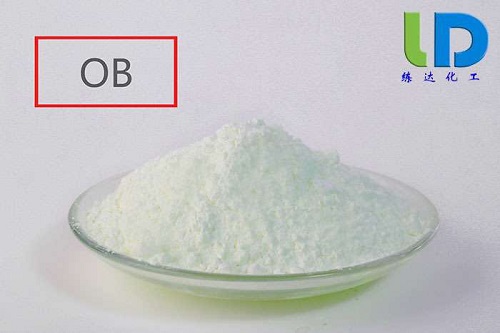
Fluorescent whitening agent OB is widely used in the plastics industry. It can be said that plastic Essential oil in optical brighteners. In the plastics industry, the usage method and amount of fluorescent whitening agent OB are also different in different production processes, such as masterbatch production and injection molding, granulation, film blowing, etc. Today Lianda Chemical will talk to you about some basic usage and dosage of optical brightener OB.
How to add optical brightener OB
When producing masterbatch, many manufacturers will also add optical brightener OB to improve the quality of the product. Compared with others, the amount of fluorescent whitening agent OB added to masterbatch production is much larger. It can add several kilograms or even more than ten kilograms per meal. This also depends on the concentration. Normally, when adding a fluorescent whitening agent to a color masterbatch, the corresponding amount of the fluorescent whitening agent OB is added directly to the masterbatch and then stirred. This mixing must be uniform, otherwise the masterbatch produced will have some problems in the next step of making products, such as white in some places and dark and yellow in other places. Therefore, normal mixing is done with a mixer, and the time can be slightly longer to achieve sufficient mixing.
But not all manufacturers have mixers, so how do they add fluorescent whitening agents? In the absence of a mixer, Lianda Chemical It is recommended to dissolve the optical brightener OB. Of course, this dissolution is not done with water, but with some organic solvents. For example, plasticizers, lubricants, etc., can dissolve the fluorescent whitening agent OB. So what is the ratio? How to add it? Take granulation as an example. When we dissolve the fluorescent whitening agent OB, we usually dissolve 2 kilograms of plasticizer and 200 grams of the fluorescent whitening agent, and instill it at the feeding port. way to join. I believe everyone has had an intravenous drip. This is how infusion is done. The flow rate is adjusted according to the production volume to ensure even addition. For example, if we granulate 500 kilograms in one hour and 1,000 kilograms in two hours, then at the end of these two hours, the dissolved fluorescent whitening agent OB solution has just finished dripping, then the whitening agent OB will be added to the 1,000 kilograms of granulation. It’s very even.
Reference dosage of optical brightener OB
As a high-end additive, the amount of optical brightener OB is very small, normal The amount of fluorescent whitening agent OB added to every 100kg of polymer:
PVC:
White 1-5 parts per 10,000 (10g-50g);
Transparent Material 0.01-0.1 (0.1g-1g) (can improve the brightness of PVC);
PS:
White 0.1 (1g);
Transparent 0.01-0.1(0.1g-1g);
ABS:
True color 1-5(10g-50g) (can effectively eliminate the yellow color inherent in ABS )
White 1-5/10,000 (10g-50g);
PE, PP:
Colorless 0.05-0.1 (0.5g-1g) ) White 0.5-5 parts per 10,000 (5g-50g);
Other plastics: For dosage, please refer to the above examples. Although the added amount of optical brightener OB is small, it has a great whitening effect.