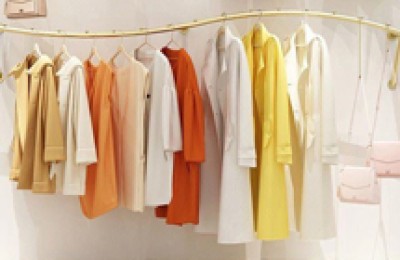

Dress is a general term for a variety. It is one of the summer clothes that people, especially young men and women, like. Dresses are known as the “Queen of Styles” among various styles. They are unpredictable, versatile and popular styles. Depending on who is wearing it, there are children’s dresses and adult dresses. Almost any combination of factors that can be varied on tops and skirts can be combined to create a dress style. Dresses can also be formed into various silhouettes and waist positions according to the needs of the shape.
There are different opinions about the origin and birthplace of the dress. There is a story that after Wu Zetian, a young and beautiful woman, became emperor, because she was too big-hearted and fat, she put on satin trousers. When she walked, she made a “chichi” sound and looked unsightly, so she simply wrapped them in a piece of satin. Lived all over the body. It turned out that although the legs were not visible in this way, due to the restraints of silk and satin, the lines appeared more graceful, and the steps looked more delicate and charming. After wearing it, the maids of the palace followed suit one after another, and they all had charm after wearing it. Then this way of dressing slowly spread outside the palace. People were very grateful to Wu Zetian for her invention. And because she was the king of a country, they added the word “clothes” next to the word “君” and named it “skirt”. So the “skirt” was passed down from generation to generation and became the love of women.
At all times and in all countries, almost no women can resist the temptation of dresses. Its gracefulness, its chicness, its sentimentality, its dignity, its charm, its curves… all make ladies moved by it. Dresses have become an indispensable part of women’s dressing up. The origin of the dress is also full of temptation and mystery. Its complexity makes more women crazy.
According to historical records, the invention of the skirt is related to the beauty Xi Shi during the Warring States Period. She sacrificed her life to save the country, but when she died, she was only wrapped in curtains. The King of Yue was so moved by Xi Shi’s spirit that women all over the country wrapped their bodies in curtains to commemorate Xi Shi. This custom, as a patriotic tradition, has been slowly passed down.
In the pre-Qin period of China, people generally wore dark clothes, which can be regarded as a variant of dresses. The lower skirt of the Zhisunfu of the Yuan Dynasty is similar to today’s pleated skirt, and also similar to a dress. However, overall, the style of dresses was relatively rare in ancient China. In modern times, Western-style dresses were introduced to China and became one of the clothes commonly worn by Chinese people.
There is also a version circulated that before World War I, the mainstream dress for women was. Elegant and elegant dresses are promoted as formal wear when attending various ceremonial occasions. With the development of the times, there are more and more types of dresses. It was introduced to my country in modern times and became one of the daily clothing of Chinese women.
None Dresses have been one of the most commonly used garments since ancient times. The deep garments with upper and lower garments connected in ancient China, as well as the tunics of ancient Egypt, ancient Greece and Mesopotamia, all have the basic shape of a dress and can be worn by both men and women, differing only in specific details.
Whether it is an accidental discovery by a gentleman of a country, or in commemoration of Xi Shi’s martyrdom, or derived from Western etiquette… dresses represent women’s pursuit and yearning for beauty, and represent women’s romantic feelings and simple and innocent emotions. Today, when we see women wearing dresses in the streets, we can still see the traces of the passage of time in the swaying skirts; in the graceful curves wrapped in the dresses, we can see the twists and turns of women over thousands of years. But his fate remains persevering. In the countless interwoven dresses, we seem to see colorful ribbons depicting ancient legends, dancing in the passionate summer…
In Europe, before World War I, the mainstream of women’s clothing had always been dresses, which were used as formal clothing for various ceremonial occasions. After World War I, as women increasingly participated in social work, the types of clothing were no longer limited to dresses, but still served as an important garment. As for dresses, most of them still appear in the form of dresses. With the development of the times, there are more and more types of dresses.
In 1973, a batch of 11 complete cotton robes of various colors and textures were unearthed from Mawangdui Han Tomb No. 1 in Changsha, Hunan. Among them, 11 pieces of cotton robes with straight gussets (i.e. dark robes) were , a total of 4 pieces. Shenyi is one of the clothing styles inherited from the Han Dynasty and the Qin Dynasty. It is actually a top and a lower garment sewn together, somewhat similar to today’s dresses. Because the quilt is deep, it is named “Shenyi”. It should be added here that the ancient lowershang is different from the skirts worn by women today. It is a bit like the apron of later generations. Of course, pants are still worn underneath the lowershang. This kind of trousers has no crotch or waistband, only two trouser legs tied around the waist with a belt, and the private parts are completely covered by the skirt.
The evolution of deep clothing has gone through two processes: first, the “curved train” was adopted. Before the appearance of dark clothes, people’s clothes were divided into two parts, namely upper and lower garments. Clothes, skirts and the trousers underneath each perform their own duties, and the skirt of the skirt and the skirt (hem) of the skirt have nothing to do with each other. Later, because the apron was removed from the deep clothing, the lower body part was not easy to deal with: if there were slits on both sides of the hem, it would inevitably lead to spring; if there were no slits, it would inevitably affect walking. In order to solve this contradiction, the ancients came up with “The method of “curved train” is to extend the skirt of the clothes to form a triangle. When wearing it, wrap it around the back and tie it with a belt. From the back, it looks like a swallowtail. In this way, it is easy to walk without being exposed. The problem of the body. When people’s underwear was perfected, it developed into “straight skirts”. Compared with the traditional tops and lower skirts, this kind of dark clothes is much easier to wear and more suitable for the body. Therefore, in the Pre-Qin Dynasty, During this period, it was the home clothes of princes, officials, and scholars, and it was also the dress of common people.
The deep cotton garment with a crimson gauze print and colorful continuous gussets and straight skirts was unearthed from Han Tomb No. 1 in Mawangdui, Changsha. The length of the dress is 130 cm, the sleeve length is 236 cm, the sleeve width is 41 cm, the cuff width is 30 cm, the waist width is 48 cm, the hem width is 57 cm, the collar edge is 29 cm wide, and the hem edge is 38 cm wide. Its style of clothing includes a crossed collar, right gusset, wild sleeves, and straight train. The sleeves and hem are both inlaid with large wide edges. A major feature of this piece of clothing is that it has a wide continuation of the gusset, that is, the skirt (called “gust” in ancient times) is set from the armpit to the lower hem, and goes straight to the hem, which seems to be the continuation of the right gusset, hence the name ” “Continue”. This kind of deep robe with wide edges and straight trains was a popular style in the Changsha area of the Western Han Dynasty, but it maintained the previous straight train form. This was done at that time to adapt to the “curved train” form just introduced. It can wrap the wide skirt around the back and tighten it with a belt, which can provide warmth in winter.
The dyeing process of this dress is also very outstanding. The clothing material has crimson as the background color. This crimson color is dyed with rubiacin through mordant dyeing. To this day, this red color is still extremely gorgeous. Printing and painting on the crimson gauze ground were called the printing and coloring process by the ancients. The printed patterns are deformed patterns of vines, using vermilion, pink and white, silver gray, gold, brown gray, black and other pigments to create flowers, leaves, buds and buds through a combined printing and painting process. Then use pink and white to outline the clouds, water patterns and dots, making the flowers and ground clear and gorgeous.
When this garment is worn, the inner fold is tucked into the left armpit, the outer fold is folded to the right side, and the bottom hem is in the shape of a trumpet. The hands are placed flat, the large sleeves droop in an arc, and the clothing pattern shows the appearance of today’s bat sleeves.
The fabric of this dark coat is transparent yarn (a light plain silk fabric with square holes). The warp and weft yarns have a fineness of 10.2 denier and the warp is very fine. Because its warp and weft densities are closer, the texture of the yarn is denser.
Tag: