
From October 14th to 21st, 2009, a delegation of Chinese business attire entrepreneurs led by the China Workwear Industry Association conducted an 8-day investigation visit to Japan. We successively visited Japan Textile Co., Ltd., Japan Descente Group, Japan IST Co., Ltd., and visited the Japan Cotton Industry Hall and the Kobe Toyota Industrial Technology Memorial Hall in Osaka. This visit further deepened the understanding and friendship between the professional attire industries of China and Japan, and also conducted meaningful discussions on how to deal with the professional attire markets of China and Japan under the financial crisis.
1. Japan’s professional wear market under the financial crisis
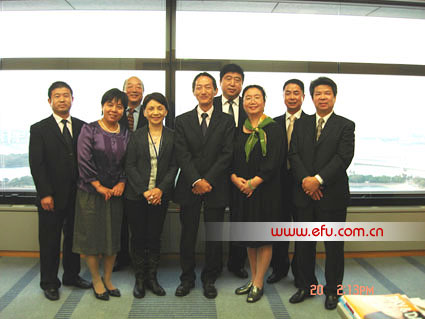
Taking a photo with senior executives of Japan IST Co., Ltd.
Japan is known as the kingdom of uniforms. Walking on the streets of Japan, professional uniforms full of professional characteristics and professional colors are enough to fully explain the concept of “uniform kingdom”. Especially in Tokyo, after get off work hours, at the entrance of the subway station, there are groups of office workers wearing suits and ties, neatly dressed, and extremely majestic. Women after get off work wear professional suits and are graceful and graceful, like a uniform kingdom. Perhaps for the reason of professional research, the members of the delegation paid special attention to the application, clothing function and design characteristics of Japanese business attire in the Japanese industry. The unique work clothes worn by employees at gas stations, on the roadside, in the subway, and at work are all designed in a reasonable and appropriate manner, and the wearer’s spiritual style is appropriately translated into work attire that ordinary people may ignore. There is no doubt that the 60 million office workers who account for one-half of Japan’s population have a need for professional attire. Therefore, the uniform kingdom is worthy of its name.
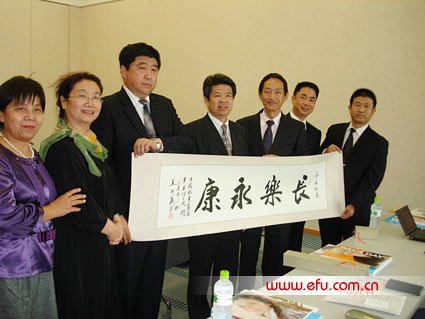
PresentagifttoPresidentYukioTaniya,PresidentoftheTokyoWomen’s Clothing Association of Japan
However, the financial crisis sweeping the world has had a fatal impact on the recovering Japanese economy, and there are concerns that it has not yet emerged from the Japan, which was under the shadow of the bubble economy 12 years ago, is even worse. More than 10 years after the collapse of the bubble economy, known as the “lost 10 years” by the Japanese business attire industry, various banks, mainly financial institutions, abolished work uniforms for female employees, which hit Japan’s business attire market. In the late 1990s, the sales volume at the peak of Japan’s bubble economy was about 700-800 billion yen, but currently Japan’s uniform terminal sluggish market sales have dropped to about 500 billion yen. Since the second half of last year, Japanese commercial enterprises have laid off a large number of employees, the performance of industrial enterprises has declined, and the demand for business attire has also increased. Therefore, the demand for Japanese business attire also has price competition issues. However, in Japan’s immature business attire market, the immaturity of demanders cannot be ignored. The clothing requirements for employees in various industries in Japan have gone through the development process of improving corporate business philosophy. In Japan, ordinary companies believe that business attire must be worn when working. This is not only a requirement of corporate philosophy, but also a requirement of people-oriented, safety and functionality. Therefore, even if the demand quantity is increasing and the price is declining, the demand for functionality of Japan’s business wear demand side will never increase. Therefore, this creates a difficulty for the Japanese professional attire industry. Under such a serious situation, the Japanese professional attire industry has further strengthened the industrial research on professional attire, increased the research and development of professional attire in the field of science and technology, and focused on higher functions, such as moisture absorption, quick drying, anti-static, sterilization, Development and application of products with special functions such as deodorization.
In response to the severe challenges in the business attire market, the Japanese business attire industry has developed an excellent team fighting spirit. To survive, Japanese business attire companies must find breakthroughs from the source. Therefore, the combination of clothing and fabrics has become the key to the survival and growth of this special industry. At present, while strengthening cooperation with fabric companies, Japanese business attire companies attach great importance to information and technology communication between the two parties, and this approach is very advanced. At the same time, increasing efforts to develop new products is also one of the practices of the Japanese professional industry amid the financial crisis. close. A Japanese company has developed a new product called thermal underwear, which is very popular in the market. The purpose of their actions is to enhance the humanized design of professional clothing in the application field and reflect the people-oriented spiritual concept of professional clothing, especially the use of new products such as reflective materials, sterilization functions, environmental protection functions, etc., in order to survive the market downturn. Under the circumstances, the company can survive and develop. To this end, the key words for the development of the entire industry are peace of mind and safety, and the second is environmental protection. In terms of environmental protection, many companies have started a uniform recycling business, making recycled business clothes into environmentally friendly bags and giving them to customers. In addition, Japan has also formulated a punishment system for companies that increase carbon dioxide emissions. All these are both difficulties and opportunities, and are new challenges faced by Japanese business attire companies in the face of the financial crisis. 
Members of the delegation at the Da Fiber and Cotton Industry Hall
2. Thinking across the ocean
In Japan, we deeply feel the impact of the financial crisis on the Japanese consumer market Pressure�, in Tokyo, known as the capital of ancient costumes, in Ginza; in Osaka, Japan’s second largest village, in Dotongo, the market downturn is self-evident. Specifically, today we are holding our purse strings and do not dare to spend money, which is in stark contrast to our country’s encouragement of people to consume and expand domestic demand. In such a comparison, we are particularly proud of China’s economic development, and are deeply moved by the improvement of China’s economic status and even the changes in its world image. Even so, there are still certain differences between us and Japan in terms of overall strength and national quality. As far as China’s professional attire industry is concerned, we still need to learn from our Japanese counterparts in a humble way.
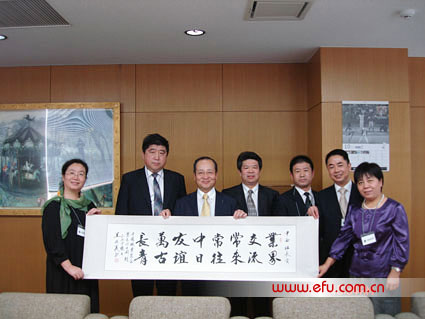
VisitJapan’s Descente Group
First, learn the business philosophy. “Uniforms make working people smile”, “pride”, “class”, “happiness”, “service”, “trust”, “peace of mind”, “responsibility” and “cleanliness” are the connotations of professional attire in the Japanese industry Understand and explain, clarifying the image and position of professional attire in the wearer. Japanese entrepreneurs once concluded that there are three realms in making professional attire: making it to satisfy the image of the enterprise or company; making it according to the needs of the wearer’s working environment and truly thinking about the wearer; and being able to truly face the challenges faced by a certain type of industry. The right customers, serve them. The second is to learn from Japanese business attire colleagues in their unremitting pursuit of creativity. The business attire industry is different from ordinary clothing companies. After all, it should be a creative industry field. Because the object we serve and its outer packaging need to be creatively designed and manufactured, we should vigorously promote the concept of creativity in the professional attire industry. The third is to learn from Japanese business attire colleagues to be perfunctory with their products and add quality to the cake. After our investigation, we saw the Japanese way of doing things and being a person, as well as the way of doing things as a whole nation, which is to do things perfunctorily and add icing on the cake. This spirit is reflected in every detail. It is even more vivid when looking at products. The requirements for sewing a piece of clothing are very strict, including the number of steps, stitches, ironing temperature and pressure. Every worker blindly follows their own work style during the implementation process, and must comply with the design requirements. The fourth is to learn the corporate spirit of creating a century-old brand from Japanese business attire peers. The historical development of China’s professional attire is relatively short. To make China’s professional attire industry bigger and stronger, we must learn from the spirit of Japanese professional attire companies in creating century-old brands. We cannot be short-sighted or foresighted. We cannot use any unscrupulous tactics to sacrifice our confidence in creating a century-old brand for the sake of long-term interests. When we investigated famous Japanese business attire companies, we found that they are all the result of centuries of inheritance. The fifth is to learn quality, integrity, self-cultivation, and consciously perform social obligations from Japanese professional attire colleagues. We investigated the industry-related integrity issues we learned from the Japanese business attire industry, including technical integrity, quality integrity, financial credit integrity, sales link integrity, integrity with customers, etc. This kind of integrity is based on blindness. Secondly, there is the issue of environmental protection. The implementation of environmental protection is basically a matter of national quality. Japan’s environmental issues have been unpopular. In recent years, Japanese business attire companies have been developing environmentally friendly clothing on environmental issues. At the Shanghai Professional Wear Exhibition, Japanese companies once exhibited professional clothing made of grass that can be buried deeply after being discarded. In recent years, Marubeni and OKI in Japan have invested heavily in environmental protection projects and developed environmentally friendly clothing. All these show that the Japanese have a strong social awareness and a high spiritual state in blindly performing social responsibilities and establishing integrity.
This article is copyrighted by Guerlain Business Wear. Please indicate the source when reprinting. Thank you for your cooperation!
Tag: